





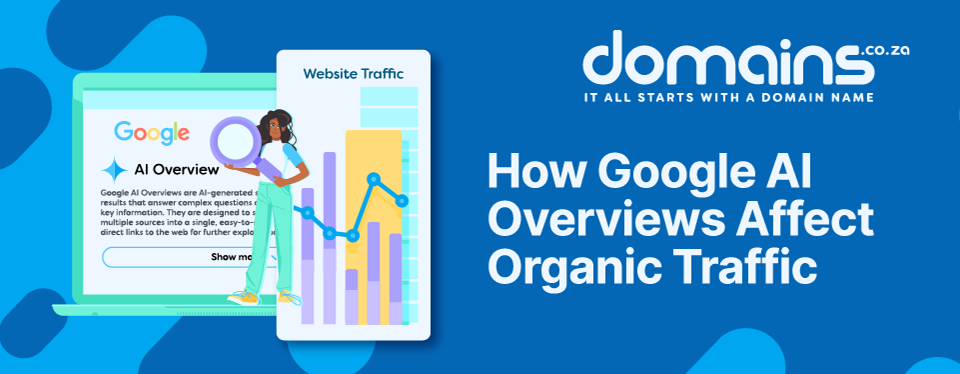
How Google AI Overviews Affect Organic Traffic: Risks, Data And Recovery Strategies
SEO has changed, and a lot, during the past two years.
Google no longer just links you to answers – it writes them itself. AI Overviews sit at the top of the SERP, synthesise information from multiple sources, and serve a complete answer before the user reaches organic listings. For anyone who has built a business on organic clicks, this is a big deal because it could mean a lot of traffic and new potential clients could now be lost.
This article looks at the data and what you can actually do to make AI Overviews work in your favour.
KEY TAKEAWAYS:
- AI Overviews are changing search behaviour.
- Organic traffic is declining for informational content.
- Original, expert-driven content is becoming more valuable.
- Technical SEO is more important than ever.
- Strong author profiles, reputable backlinks, updated content and topical expertise increase the likelihood of being referenced.
- Businesses should focus on conversions, branded searches, AI citations and visibility rather than traffic alone.
- Email marketing, social media, YouTube and brand-building help reduce dependence on Google organic traffic.
- A strong website foundation with a reputable web hosting provider like Domains.co.za can help to drive long-term SEO success.
TABLE OF CONTENTS
What Google AI Overviews Are
AI Overviews are AI-generated summaries that appear in Google Search for most queries right now. They combine information from several sources into one inline answer positioned above or near traditional organic results. Launched in the US in May 2024, they evolved from the earlier Search Generative Experience.
They are not the same as featured snippets. Featured snippets typically pull content from one page, while AI Overviews synthesise across multiple sources, often citing several sites at once.
Google’s own Search Central documentation says standard SEO best practices still apply to AI features, but site owners should also understand how their content may appear and be used in AI-powered search. The user journey has already shifted because the answer arrives even before the first click.
What the Data Says
The numbers paint a clear picture.
Ahrefs analysed 300,000 keywords and found that:
- AIO (AI Overview) correlates with a 34.5% lower average clickthrough rate for the top-ranking page, compared to similar informational keywords without one.
- For AIO-triggering keywords specifically, position-one CTR on desktop dropped from 7.3% in March 2024 to 2.6% in March 2025 – roughly a 64% reduction for that specific segment. The study was updated in June 2026 and confirmed the trend has not reversed.
The scale of AI Overviews is larger than most website owners realise. Ahrefs found that AIOs appear for 9.46% of all keywords globally and 16% in the US.
By search volume, 12.8% of all Google searches now show an AI Overview. The top 50 domains hold 28.9% of all AIO mentions. And almost 100% of AIO-triggering keywords have informational intent.
This year, the situation became even worse. After Google’s March 2026 Core Update, AI Overview presence grew by 116%.
Seer Interactive found that AI Overviews appear on nearly 65% of question-based searches – the exact queries most informational content targets.
The same study noted that domains with zero author bios (like Reddit) account for 20.4% of AIO first-citation slots, while “perfect SEO” publishers with the highest author-bio rates had the lowest AIO citation share.
Which Queries Are Most at Risk
Not all keywords are affected equally.
- High risk: “What is” queries, “How does” questions, simple definitions, basic comparisons, quick troubleshooting guides, top-of-funnel educational content, generic listicles. Anything where the user wants a quick, factual answer.
- Lower risk: Branded searches, local intent searches, transactional queries, complex decision-making content, original research, opinion-led analysis, interactive tools, templates, and product pages.
The easier it is for an AI to summarise your content, the less reason a user has to click through.
The Biggest Risks for Site Owners
Risk 1: Traffic declines even when rankings stay stable. AI Overviews sit above organic results. A page can hold position one and still lose a third of its clicks.
Risk 2: Content becomes an unpaid data source. AI uses your information while fewer users visit your site.
Risk 3: Publishers lose monetisation. Fewer clicks means fewer ad impressions, fewer affiliate conversions, fewer newsletter signups.
Risk 4: Attribution gets harder. AI search traffic appears inconsistently in analytics. You may not know what you are losing.
Risk 5: The metric that matters shifts. The question is no longer “Do we rank?” but “Does AI trust and cite us?”
Are AI Overviews the End of Organic Search?
AI Overviews are not purely destructive. Ahrefs data shows that nearly 30% of AIO-cited domains in their study did not appear in the traditional first-page results, suggesting that AI source selection can differ from classic ranking algorithms.
The opportunity is real but specific. Strong topical authority, clear structured content, and original data all improve the odds of being cited.
Recovery Strategy 1: Audit Keywords by AI Overview Risk
Start with your own data.
Export your top organic queries from Google Search Console. Look for pages with stable impressions but falling clicks. That combination – steady visibility, declining engagement – is a hallmark of AI Overview encroachment.
Group keywords by intent: informational, commercial, transactional, branded. Prioritise recovery for pages tied to business outcomes, not just traffic volume. Check which queries actually trigger AIOs using Ahrefs, Semrush, or similar tools that filter by AI Overview presence in the SERP.
Recovery Strategy 2: Make Content Citation-Ready
AI systems extract answers from content that is easy to parse. This does not mean you should be writing just for machines. You should organise your information so it can be understood and cited by both humans and robots.
- Use headings that match real user questions.
- Answer the main question early.
- Add concise definitions.
- Include original examples.
- Cite reputable external sources.
- Add author bios and expert reviewers.
- Keep dates current.
- Use statistics, tables and summaries. Short answer sections, FAQ blocks, step-by-step instructions and comparison tables all help.
The technical foundation of your website also matters – speed, HTML structure, keywords filling your website, etc.
How to make your website ready for AI citations?
AI website builders should be one of the parts of your toolkit. They automatically handle semantic HTML, heading structure, responsive design, image optimisation, metadata, and XML sitemaps. For example, a website builder like Site.pro can fully optimise your website’s content for your keywords of choice.
Although AI website builders do not guarantee AI citations, they reduce many of the technical barriers that stop content from being discovered. This is important for small businesses without dedicated SEO teams – Site.pro, Wix, Durable, Framer AI, Webflow AI and Shopify’s AI features help to create technically sound websites faster. The priority is not simply “AI-generated design”; it is whether the builder produces clean code, mobile-friendly pages, editable metadata, structured content sections, schema options, fast-loading pages and sitemap support.
Tools such as Other useful AI-friendly website tools include:
Structured data tools
Schema markup helps search engines understand entities, relationships and page purpose. Schema.org is the shared vocabulary used for structured data across the web, including JSON-LD, Microdata and RDFa formats.
Tools such as Google’s Rich Results Test, Schema Markup Validator, Rank Math, Yoast SEO, Schema App and built-in website builder schema features can help validate whether the markup is technically correct.
Technical SEO tools
AI citation readiness starts with basic discoverability. Google Search Console, Bing Webmaster Tools, Screaming Frog, Sitebulb, Ahrefs, Semrush and JetOctopus can help identify crawl errors, broken links, missing metadata, duplicate content, poor internal linking and sitemap issues.
RELATED: Ticking The Technical SEO Box
Content optimisation tools
Clearscope, Surfer SEO, MarketMuse, Frase and AlsoAsked can help map search intent, related questions and topic gaps. They should be used to improve coverage and clarity, not to produce generic AI-written pages. AI systems are more likely to cite content that gives a direct, specific and verifiable answer than pages filled with vague keyword repetition.
Performance and accessibility tools
Fast, accessible websites are easier to crawl and use.
PageSpeed Insights, Lighthouse, WebPageTest and accessibility checkers such as WAVE or Axe can help improve loading speed, Core Web Vitals, alt text, heading order and mobile usability. These improvements support both human visitors and machine interpretation.
Content control tools
Website owners should also understand how their content may appear and be used in AI-powered search. Google documents robots meta tags, X-Robots-Tag, nosnippet, max-snippet, max-image-preview and data-nosnippet as ways to control how content can be shown in Search results and related AI experiences. These controls are important for publishers that want visibility but also need to manage how much content is surfaced.
Recovery Strategy 3: Shift From Generic to Original
Generic informational content is exactly what AI replaces most easily.
The solution is content AI cannot write from a web crawl. Original research. Industry benchmarks. Case studies with real numbers. Expert interviews. Opinionated analysis. Tools and calculators. Product comparisons backed by first-hand testing.
Instead of “What is AI search?”, publish “How AI Search Changed Organic Traffic for 50 Businesses: Data and Lessons.” The second title carries information the AI cannot synthesise from public sources.
Recovery Strategy 4: Strengthen Authority Signals
AI search systems favour sources that look trustworthy.
- Build detailed author profiles.
- Show real company information.
- Add editorial standards to your publication process.
- Earn high-quality backlinks from authoritative domain names.
- Get mentioned on trusted third-party sites.
- Publish original data.
- Keep content updated.
- Create topic clusters around your area of expertise.
Recovery Strategy 5: Optimise for Conversion, Not Just Traffic
If AI Overviews reduce top-of-funnel clicks, every remaining visit becomes more valuable.
Add stronger calls to action. Promote newsletter signups. Offer downloadable resources. Create comparison pages that capture commercial intent. Improve internal linking to move users from informational content toward product pages. Build remarketing audiences. Capture demand from branded searches.
The future of SEO is not about recovering every lost visit. It is about turning fewer but more qualified visitors into measurable outcomes.
Recovery Strategy 6: Diversify Beyond Google
Relying exclusively on Google organic traffic is now a concentration risk.
- Develop email newsletters.
- Build a YouTube presence.
- Publish on LinkedIn.
- Engage on Reddit and community platforms.
- Invest in direct traffic through brand recognition.
- Run webinars and podcasts.
- Use paid search for high-intent terms where AI Overviews do not appear.
Strong brands depend less on generic informational keywords. When users search for your name, AI Overviews don’t matter.
Recovery Strategy 7: Track New SEO and AI Search Metrics
- Track organic CTR by query.
- Monitor AI Overview presence for your key terms.
- Measure brand mentions in AI tools.
- Watch branded search volume as a proxy for demand.
- Track direct traffic trends.
- Report on assisted conversions and content-influenced pipeline.
SEO reporting needs to evolve from traffic reporting to visibility reporting – covering citations, brand demand and business impact.
A 30-Day Recovery Plan
Week 1 – Diagnose: Identify pages with falling CTR. Map affected queries to intent categories. Check AI Overview presence for your key terms.
Week 2 – Improve: Add concise answer sections to exposed pages. Update outdated claims. Improve content structure and internal linking.
Week 3 – Build Authority: Strengthen author bios and topic clusters. Publish at least one piece of original data or analysis. Ensure your site’s technical foundation handles schema, crawlability and structured data properly.
Week 4 – Convert and Diversify: Add CTAs and email capture to high-value pages. Repurpose core content for LinkedIn, YouTube or a newsletter. Start tracking AI visibility and branded search trends.
Conclusion
Google AI Overviews are changing how users find information. Organic traffic will decline for many informational queries, it’s already happening.
The brands that adapt will stop optimising for rankings alone. Instead, they will optimise for trust, citations, authority, original value, conversion quality, and multi-channel presence.
SEO is not dead, but its job has changed. The goal is no longer to win the click, but to earn the mention, the trust, and the visit that follows.
As search evolves, the foundation of your website matters more than ever. Domains.co.za provides the reliable Web Hosting, Domains and website solutions businesses need to stay visible, competitive and ready for the future of AI-powered search.
![Strip Banner Text - A strong website foundation, supported by reliable hosting like Domains.co.za, is key to long-term SEO success. [View Hosting Plans]](https://www.domains.co.za/blog/wp-content/uploads/2026/07/blog-exchange-04.webp "A strong website foundation, supported by reliable hosting like Domains.co.za, is key to long-term SEO success. [View Hosting Plans]")
How to Choose the Right Web Hosting Plan for Your Website
VIDEO: How to Choose the Right Web Hosting Plan for Your Website
FAQS
What are Google AI Overviews?
Google AI Overviews are AI-generated summaries that appear at the top of search results, combining information from multiple sources to answer queries directly on the SERP.
How do AI Overviews affect organic traffic?
They can reduce organic clicks by answering user questions directly in search results, even when a page ranks in position one.
Which types of content are most affected?
Informational content such as “what is,” “how to,” definitions, listicles, and basic comparisons are most at risk of reduced traffic.
Does ranking number one still guarantee traffic?
No. Even top-ranking pages can lose significant clicks because AI Overviews often appear above organic listings.
How does web hosting impact SEO and AI visibility?
Reliable hosting, like that offered by Domains.co.za, supports faster load times, better uptime, and stronger technical SEO foundations—all of which help search engines crawl, understand, and potentially surface your content in AI-driven results.
How can businesses recover lost traffic?
By improving content structure, focusing on original insights, strengthening authority signals, diversifying traffic sources, and optimising for conversions rather than clicks alone.
Are AI Overviews the end of SEO?
No. SEO is evolving rather than disappearing. The focus is shifting from rankings and traffic to visibility, authority, and being cited in AI-driven search results.
Other Blogs of Interest
- SEO Best Practices For Your WordPress Website
- Top On-page SEO Factors to Include when Building your Website
- OpenAI’s GPT-5.5-Cyber: Revolutionary Cybersecurity Or Potential New Threat?
- Anthropic’s Claude Mythos AI: A Product Launch Or A Warning?

Chantél Venter is a creative writer, strategic thinker, and a serious gesticulator. She’s passionate about storytelling, small businesses and bringing color to the world – be it through her words or wardrobe.
She holds a four-year degree in Business and Mass Media Communication and Journalism. She’s been a copywriter and editor for the technology, insurance and architecture industries since 2007 and believes anybody can run a small business successfully. She therefore enjoys finding and sharing the best and most practical tips for this purpose.