




Do Keywords In Domain Names Still Matter For SEO In 2026?
Keywords in domain names have long been debated in the SEO world. Do they actually help your website rank? Should you choose a domain name that describes what your business does, or is it better to use your brand name?
The short answer is ‘yes’, keywords in a domain name can still matter – but not in the way they once did.
A keyword-rich domain name is no longer a shortcut to the top of Google. Search engines have become far better at understanding the quality, relevance and intent behind a website. Your domain name alone will not make a poorly SEO-optimised website rank.
However, a well-chosen domain can still influence relevance, brand recall, click-through rates and how clearly visitors understand what your business offers. For South African businesses, choosing the right domain extension, such as .co.za, can also help establish a clear geographic connection.
So, if you are wondering whether domain names affect SEO, the answer is nuanced. The domain is one piece of the bigger SEO picture – and getting it right can still be valuable.
RELATED: .ZA Domain Name Extensions: How Going Local Can Help Your Business Grow
KEY TAKEAWAYS
- Keywords in domain names still matter – but they aren’t an SEO shortcut.
- Exact Match Domains no longer have the ranking advantage they once did.
- Choose a domain that works for people, not just search engines.
- A keyword + brand domain can offer the best of both worlds.
- For South African businesses, .co.za can reinforce local relevance.
- Search Domains.co.za for an available domain name that makes your business easy to find and remember.
TABLE OF CONTENTS
How Domain Keywords Historically Influenced SEO
To understand why keywords in domain names are still discussed in SEO, it helps to look at how things used to work.
An Exact Match Domain (EMD) is a domain name that exactly matches, or closely matches, a search query. For example, if someone searched for “Cape Town plumbers”, a domain such as capetownplumbers.co.za would be an example of a keyword-rich or Exact Match Domain.
For many years, having the exact words people searched for in your domain could provide a significant ranking advantage. This led to businesses registering domains that consisted almost entirely of popular search terms.
The problem was that this could be exploited.
A domain containing a popular keyword did not necessarily mean that the website behind it offered the best answer, product or service. Some websites were created primarily to take advantage of keyword-based rankings, with little original or useful content.
Google addressed this with its Exact Match Domain update in 2012. The update reduced the ranking advantage previously associated with low-quality Exact Match Domains.
This was an important shift.
Google was effectively moving away from the idea that a website should rank simply because its domain happened to contain the words someone searched for. Instead, other signals – including the quality and relevance of the website’s content – became much more important.
That does not mean keywords in domains became completely irrelevant.
It means that a keyword in a domain should be viewed as one supporting signal rather than an SEO shortcut.
What Does Google Say About Keyword Domains Today?
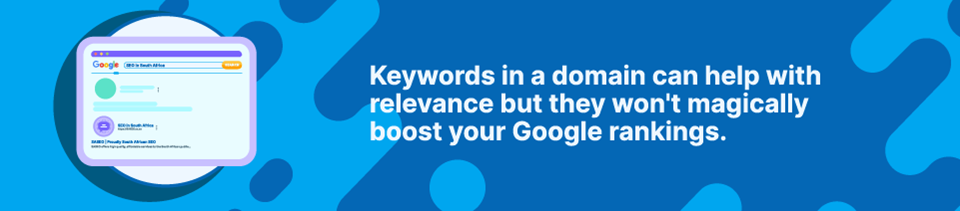
Today, Google does not treat having a keyword in your domain name as a ‘magic’ ranking button.
In other words, registering a domain such as ‘bestplumber.capetown’ does not automatically make your website more likely to rank when someone searches for “best plumber” in Cape Town.
Google’s John Mueller has previously explained that keywords in domain names do not provide a special ranking boost for those keywords. What matters much more is whether your website provides useful, relevant content that satisfies what the searcher is looking for.
This is an important distinction when considering the best domain name for SEO.
Your domain name can help communicate what your business is about, but it cannot replace good SEO.
Think of it this way:
Your domain name tells people who you are or what you do. Your website needs to prove that you are worth choosing.
That means your SEO strategy should still focus on things such as:
- Creating useful, original and relevant content
- Understanding and matching search intent
- Building your website around the needs of your customers
- Earning quality links and mentions
- Making your website easy to navigate
- Providing a good experience across devices
- Maintaining a technically sound website with fast and reliable Web Hosting
Your domain is the foundation on which all of this sits.
What About .CO.ZA and SEO in South Africa?
For South African businesses, the domain extension you choose can also communicate where you operate.
A .co.za domain is the country-code domain extension associated with South Africa. It immediately tells visitors – and search engines – that your business has a South African connection.
This can be particularly useful when your customers are primarily based in South Africa, and you want your website to be associated with the local market.
For example, if you operate a plumbing business in South Africa, a domain such as yourbrand.co.zaclearly establishes your local relevance. If you combine this with a relevant keyword, such as a service or location, you can communicate even more information without sacrificing your brand.
The key is not to choose a domain purely because you think its keywords will make you rank. Choose one that makes sense for your business, audience and market.
When Can a Keyword-Rich Domain Name Help?
A keyword-rich domain name can still be useful when the words are relevant, natural and easy for people to understand.
1. Local service businesses
Keyword domains can work particularly well for businesses offering a specific service in a specific location.
Imagine a business providing pool maintenance in Johannesburg. A domain that combines the service, location and brand could make the business immediately understandable; for example: yourbrandpoolcare.co.za.
The domain tells people what the company does while still giving the business a recognisable brand element.
This is different from choosing an extremely generic domain simply because it contains a high-volume keyword.
For local businesses, clarity can be valuable. Someone seeing the domain in a search result, social media post, email or advertisement can immediately get an idea of what the business offers.
2. Niche ecommerce businesses
A keyword-rich domain can also make sense for a highly focused online store.
Consider a business selling a specific type of product. Including a relevant product category in the domain can help communicate the site’s purpose.
For example, a specialist business selling hiking equipment might choose a name that combines its brand with a relevant category.
This can make the website easier to understand at a glance and potentially improve brand recall.
Again, however, the keyword is not what makes the website successful on Google. The site still needs quality product pages, useful information, good technical SEO and a strong customer experience.

3. Businesses starting from scratch
If you have not yet established a brand, a keyword can sometimes help you communicate what you do while you build recognition.
A domain that gives customers an immediate clue about your business can be easier to remember than a completely unrelated word.
But there is an important consideration: you are also building a brand.
If your business grows, expands into new services or enters new markets, a highly specific keyword domain may eventually feel restrictive.
When Can a Keyword Domain Hurt Your Brand?
The biggest risk with keyword domains is not necessarily SEO. It is brand dilution.
Imagine you want to build a business that starts by selling running shoes but may eventually expand into sportswear, fitness accessories and outdoor products.
A domain such ascheaprunningshoes.co.za may describe your original offering, but what happens when you start selling much more?
Your domain has now become a limitation.
There is also a difference between a domain that sounds like a legitimate business and one that sounds as though it was created purely to capture search traffic; for example: fastfeet.co.za vs. bestcheaprunningshoesonline.co.za.
The first sounds like a brand. The second is difficult to remember, difficult to say aloud and gives the impression that keywords were prioritised over the customer.
A good domain should work beyond Google. People need to be able to remember it, spell it, say it and associate it with your business.
The Keyword + Brand Approach
For many businesses, the sweet spot is somewhere between a purely branded domain and a purely keyword-based domain.
This is the keyword + brand hybrid approach. Instead of choosing between a completely branded domain and domain made entirely from keywords you can combine the two.
EXAMPLE::
yourbrandplumbing.co.za
yourbrandflowers.co.za
yourbrandfitness.co.za

or, for a location-focused business:
yourservice.capetown
This approach gives you the opportunity to communicate what you do while still building something that belongs to your business. It also gives you greater flexibility as your brand develops.
When registering a domain name, consider these questions:
- Is it memorable?
- Will someone remember it after seeing it once?
- Is it easy to spell?
- If a customer hears your domain in a conversation or on a radio advert, will they know how to type it?
- Does it make sense?
- Does the name give people a useful indication of what your business does?
- Does it fit your brand?
- Would you be happy putting it on your business cards, social media profiles, packaging and signage?
- Can your business grow with it?
- Will the domain still make sense if you introduce new products or services?
- Does the extension make sense for your market?
If you primarily operate in South Africa, a .co.za domain can provide a clear local signal and help reinforce your connection to the South African market.
How Long Should a Domain Name be for SEO?
There is no magic character count that will make a domain rank better. However, shorter domains are generally easier for people to remember, type and share.
As a practical rule, try to keep your domain to one to three words where possible and avoid unnecessarily long combinations of keywords.
For example: brandplumbing.co.za is likely to be easier to remember and communicate than
bestaffordableplumbingservicesinjohannesburg.co.za
The first is also more likely to remain useful if your business expands.
Added to this, SEO should not be the only consideration when choosing a domain name. A domain that gets people to your website but is impossible to remember is not doing its job particularly well.
How to Choose the Right Domain Name for Your Business
Start by deciding what you want your domain to achieve. If building a strong, long-term brand is your priority, a branded domain may be the best option.
If your business is highly specialised and your service or product needs to be immediately clear, incorporating a relevant keyword could make sense. And if you want to do both, consider a keyword-brand combination.
Once you have a few ideas, check whether the domains are available before becoming too attached to one.
You can use the Domains.co.za domain search tool to search for available domain names and explore different extensions for your business. Or alternatively, if you need some help choosing, you can use Domains.co.za AI Domain Name Generator.
Choose something that your customers can remember, your team can confidently promote, and your brand can grow into.
Don’t sacrifice your brand just to squeeze another keyword into your domain. Instead, look for a name that is memorable, relevant, easy to market and flexible enough to grow with your business.
Ready to find yours?
Search for your domain name with Domains.co.za and find a domain that works for your brand.
![Strip Banner Text - A great domain should be easy to remember, easy to market and relevant to your customers. [Search Now]](https://www.domains.co.za/blog/wp-content/uploads/2018/09/keywords-in-domains-04.webp "A great domain should be easy to remember, easy to market and relevant to your customers. [Search Now]")
How to Choose & Register the PERFECT Domain Name
VIDEO: How to Choose & Register the PERFECT Domain Name
FAQS
Do keywords in a domain name help SEO?
Keywords in domain names can provide a minor SEO signal and may help with relevance, brand recall and click-through rates, but they are not a major ranking factor. Google places much greater importance on useful content, relevance, user intent and other established SEO signals.
What is an Exact Match Domain (EMD)?
An Exact Match Domain contains the precise search query as the domain name. For example, a search for “Cape Town plumbers” and a domain such as capetownplumbers.co.za. Google’s 2012 EMD update significantly reduced the ranking advantage previously associated with low-quality Exact Match Domains.
Should I use a keyword domain for my South African business?
A keyword-brand hybrid can be a useful option for a South African business. Combining your brand with a relevant service or location can help communicate what you offer while supporting brand recall. Avoid choosing a domain purely for its keywords if it makes your business look generic or spammy.
Does a .co.za domain help with local SEO in South Africa?
A .co.za domain provides a clear geographic signal that your website is associated with South Africa. For businesses targeting customers in South Africa, this can reinforce local relevance. However, a .co.za domain alone does not guarantee higher rankings.
How long should a domain name be for SEO?
There is no specific domain length that guarantees better SEO. Shorter domains are generally easier to remember, type and share. Aim for one to three words where possible and avoid unnecessarily long strings of keywords.
Other Blogs of Interest
- How To Register Or Transfer Your Domain Name
- 14 Questions About Domain Names And Website Hosting Answered
- Transfer Domain Names: The What, Why, How & Where
- Register A .AI Domain Name & Position Your Tech Brand For The AI Era
- Choose A .ORG Domain Name To Build Your Mission Online

Chantél Venter is a creative writer, strategic thinker, and a serious gesticulator. She’s passionate about storytelling, small businesses and bringing color to the world – be it through her words or wardrobe.
She holds a four-year degree in Business and Mass Media Communication and Journalism. She’s been a copywriter and editor for the technology, insurance and architecture industries since 2007 and believes anybody can run a small business successfully. She therefore enjoys finding and sharing the best and most practical tips for this purpose.